

Express Entry Changes in 2026 Explained
If you have been researching Canadian permanent residence, you may have heard that IRCC introduced several changes to Express Entry in 2026.
The good news is that if you already understand how Express Entry works, you do not need to learn a completely new system. The Canadian Experience Class (CEC), Federal Skilled Worker Program (FSW), Federal Skilled Trades Program (FST) and the Comprehensive Ranking System (CRS) all remain the same.
Instead, most of the changes relate to who IRCC chooses to invite, not how Express Entry itself operates.
What Is Category-Based Selection?
The easiest way to understand category-based selection is with an example.
Imagine there are 100,000 candidates in the Express Entry pool.
During a regular Express Entry draw, IRCC ranks all candidates by their CRS score and invites the highest-scoring applicants.
Now imagine Canada needs more healthcare workers.
Instead of reviewing all 100,000 candidates, IRCC conducts a healthcare draw. Only candidates who qualify under the healthcare category are ranked, and the highest-ranking healthcare candidates receive Invitations to Apply (ITAs).
For example:
Sarah is a registered nurse with a CRS score of 472.
John is an accountant with a CRS score of 515.
If IRCC holds a general draw requiring a CRS score of 515, John would receive an invitation while Sarah would not.
However, if IRCC later holds a healthcare draw with a CRS cut-off of 465, Sarah may receive an invitation even though her CRS score is lower. This is because only eligible healthcare candidates are being considered during that draw.
Think of category-based selection as an additional opportunity to receive permanent residence. You still participate in general Express Entry draws, but if you qualify for one or more categories, you may also be considered during category-based draws.
Why Did IRCC Introduce These Changes?
Canada needs more workers in certain occupations than others.
Under the previous system, invitations were issued primarily based on CRS scores. This sometimes meant that workers in occupations experiencing labour shortages were not receiving invitations because their CRS scores were below the general cut-off.
The 2026 changes give IRCC greater flexibility to invite workers in occupations that are particularly important to Canada's economy while continuing to use the existing Express Entry system.
Express Entry Categories in 2026
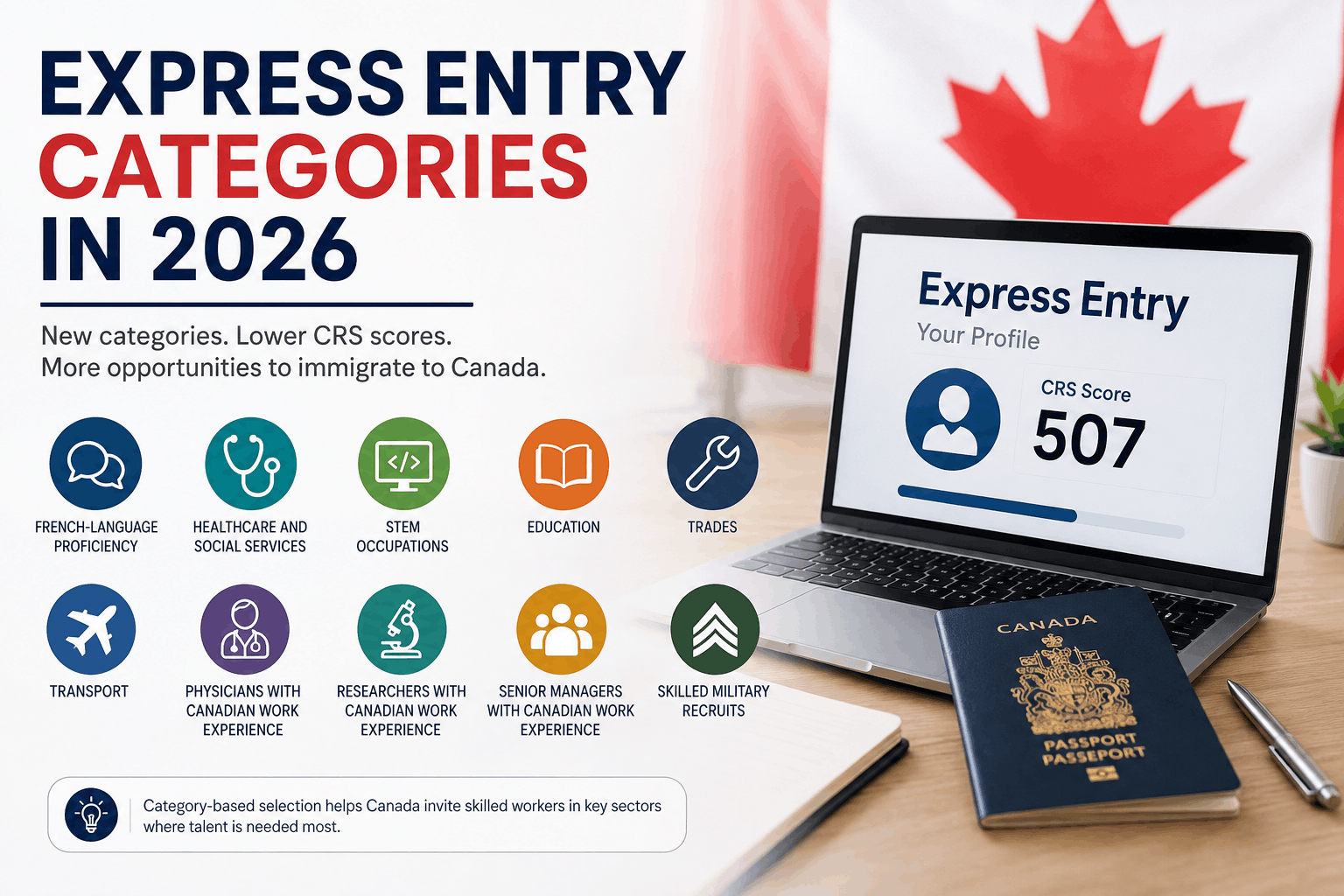
As of 2026, IRCC has ten category-based selection categories.
-
Candidates with strong French language skills
-
Nurses, physicians, pharmacists, social workers
-
Software engineers, computer programmers, engineers, data scientists
-
Teachers, early childhood educators
-
Electricians, plumbers, welders, carpenters
-
Pilots, truck drivers, railway and marine occupations
-
Medical doctors
-
University researchers and research assistants
-
CEOs, presidents, vice-presidents
-
Certain foreign military personnel
Important: These are only examples. Simply working in one of these industries does not automatically qualify you for a category.
Each category has a specific list of eligible occupations published by IRCC. In addition, IRCC primarily determines your occupation by comparing your actual job duties with the National Occupation Classification (NOC), not simply by looking at your job title.
What New Categories Were Added?
Physicians with Canadian Work Experience
Doctors with eligible Canadian work experience may now receive invitations through physician-specific category draws instead of relying only on general Express Entry draws.
Researchers with Canadian Work Experience
Certain university researchers and research assistants with eligible Canadian work experience now have their own category, giving them another opportunity to receive an Invitation to Apply.
Senior Managers with Canadian Work Experience
This category is much narrower than many people expect.
It is not intended for restaurant managers, retail managers or office managers.
Instead, it mainly applies to executive positions such as CEOs, presidents and vice-presidents who meet IRCC's eligibility requirements.
Transport
Canada introduced this category to help address labour shortages in transportation. It includes certain eligible aviation, trucking, railway and marine occupations.
Skilled Military Recruits
This category applies to certain foreign military personnel who have received a qualifying job offer from the Canadian Armed Forces.
Do Category-Based Draws Have Lower CRS Scores?
In many cases, yes.
One of the main advantages of category-based selection is that the CRS score required to receive an Invitation to Apply (ITA) is often lower than in a general Express Entry draw.
For example, during 2026:
Canadian Experience Class (general draw): 507–518
French-language proficiency: 393–420
Healthcare and social services: 467–475
Trades: 477
Senior managers with Canadian work experience: 392–429
Physicians with Canadian work experience: 169–223
Skilled military recruits: 368
As you can see, several category-based draws have had significantly lower CRS cut-off scores than general Express Entry draws.
However, there is no guaranteed CRS score for any category. The cut-off depends on several factors, including the number of eligible candidates in the Express Entry pool, the number of invitations IRCC decides to issue and the category selected for that draw.
For that reason, it is impossible to predict the exact CRS score that will be required for future category-based draws. Even if you qualify for a category, you should continue taking steps to improve your CRS score whenever possible.
Can You Qualify Under More Than One Category?
Yes.
Many candidates qualify under multiple categories at the same time.
For example:
A French-speaking nurse may qualify under both the Healthcare and French-language categories.
A French-speaking software engineer may qualify under both the STEM and French-language categories.
This gives those candidates additional opportunities to receive an Invitation to Apply if IRCC holds draws for either category.
Common Mistakes
Many applicants assume that working in healthcare, technology or education automatically qualifies them for a category-based draw.
This is not true.
Each category has a specific list of eligible occupations, and IRCC primarily looks at your job duties, not simply your job title.
Another common misunderstanding is that qualifying for a category guarantees an Invitation to Apply. It does not. IRCC decides when to hold category-based draws, how many invitations to issue and what CRS score will be required for each draw.
Another Important Change: One Year of Work Experience
IRCC also increased the minimum work experience requirement for several existing categories.
Previously, many candidates became eligible after 6 months of eligible work experience.
Beginning in 2026, they generally need 1 year of eligible work experience gained within the previous three years.
This change applies to:
Healthcare
STEM
Education
Trades
For many candidates, this simply means waiting longer before becoming eligible for category-based draws.
Important: This change applies to eligibility for these category-based draws. It does not change the eligibility requirements for the Canadian Experience Class itself.
Learn how to find an Express Entry-eligible job here.
What Has Not Changed?
Despite the 2026 updates, the core Express Entry system remains the same.
The following have not changed:
The Canadian Experience Class (CEC)
The Federal Skilled Worker Program (FSW)
The Federal Skilled Trades Program (FST)
The CRS scoring system
Category-based selection is not a new immigration program. It is simply another way for eligible candidates to receive an Invitation to Apply.
Final Thoughts
The 2026 Express Entry changes have made Canada's economic immigration system more targeted rather than completely different.
If your occupation falls within one of IRCC's eligible categories, confirming your correct NOC code and understanding the category requirements may significantly improve your chances of receiving an Invitation to Apply.